What Types of Appliance Injection Parts Are Available?
Appliance Injection Parts are the molded components that help household equipment function, fit together, and withstand repeated use. They range from refrigerator bins and washing-machine bezels to dishwasher spray-arm components, vacuum housings, and small control knobs. Their differences are practical: size, shape, material, surface finish, and exposure to heat, moisture, detergents, or impact. A clear overview helps buyers and product teams identify which part types suit a specific appliance—and what to check before specifying them.
The scale of the challenge is significant. The Global E-waste Monitor 2024, published by the United Nations Institute for Training and Research and partner organizations, reports that the world generated 62 million tonnes of electronic waste in 2022; only 22.3% was formally collected and recycled. This figure covers many product categories, not appliances alone, but it underlines why durability, repairability, and material choices deserve attention. Small molded parts can matter. A cracked latch or ill-fitting cover may affect an otherwise serviceable machine.
This guide examines common Appliance Injection Parts by appliance type and function, then explains the features that distinguish them. It also considers material selection, tolerances, finishes, and production needs. A part that looks simple may face years of vibration and temperature changes. That is easy to underestimate. The right choice depends on real operating conditions, not appearance alone; even this overview cannot replace a part drawing, sample inspection, or engineering review.
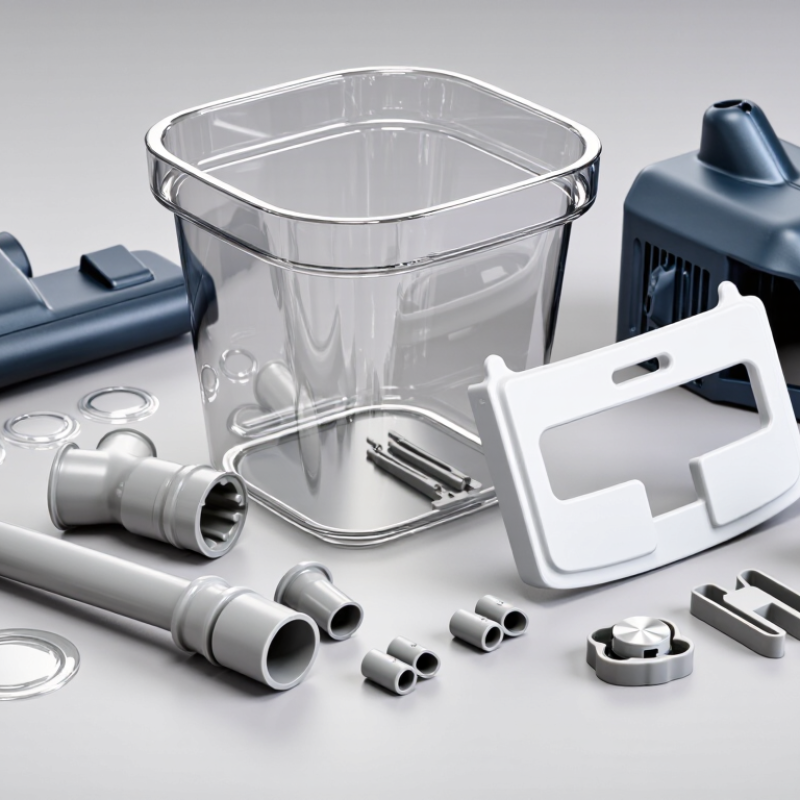
Classify Appliance Injection Parts by Function: Housings, Knobs, and Fluid Paths
Appliance injection parts make more sense when classified by function. Housings protect motors, wiring, and control boards from dust and everyday knocks. Their ribs and screw towers add stiffness without making the wall unnecessarily thick. A thin corner can still warp. That detail deserves attention during mold design and testing.
Knobs and buttons transfer a person’s touch to a control mechanism. Their small features matter: a textured rim improves grip, while a tight shaft fit limits wobble. Fluid-path parts include reservoirs, inlet connectors, and drain channels. These components must guide water smoothly and resist leaks at joints. Flow testing can reveal trapped pockets or uneven drainage. Simple, but critical.
Material choices also affect durability and manufacturing waste. The OECD’s Global Plastics Outlook reports that global plastics production reached 460 million tonnes in 2019. That figure covers all plastics, not appliance parts specifically, but it underscores why material efficiency matters. Designers can reduce excess resin through balanced wall thickness and careful gate placement. Still, lighter is not always better. A housing that flexes too much may fail in use, and a fluid connector needs dependable sealing surfaces. Real testing should confirm the trade-offs. Source: OECD, Global Plastics Outlook, 2022.
Housings protect internal components, knobs provide user controls, and fluid paths guide water or other liquids. The bars show illustrative typical wall-thickness ranges in millimeters; actual requirements vary with material, geometry, and operating conditions.
Match Common Resins to Part Needs: ABS, PP, HIPS, and Glass-Filled Nylon
Appliance injection-molded parts often face heat, repeated handling, cleaning agents, and tight assembly tolerances. The right resin depends on the part’s job, not just its shape. ABS suits rigid covers, control-panel housings, and trim where a smooth surface and good dimensional stability matter. It is easy to finish, but prolonged heat or harsh chemicals may cause trouble. Check the appliance’s operating conditions before specifying it.
PP is a practical choice for bins, interior liners, and components that benefit from low weight and resistance to many household chemicals. Its flexibility can help with snap-fit features, though thin sections may warp if the part is poorly designed or processed. HIPS offers a balance of stiffness and impact resistance for interior panels and non-structural covers. It can be economical, but it is not ideal for every hot or heavily loaded area. Small details matter.
For brackets, supports, or parts exposed to higher mechanical loads, glass-filled nylon can provide greater stiffness and strength than unfilled plastics. The fibers may also increase wear resistance. But they can make thin edges more brittle and leave visible surface texture. Tooling and flow direction affect the result, so a sample part is worth testing. Resin choice is rarely perfect; a material that works well in one appliance may disappoint in another. Match the grade to temperature, load, moisture exposure, and molding geometry.
Set Wall-Thickness Targets: Typical Injection-Molded Walls Are About 1–4 mm
For appliance injection parts, a wall thickness of about 1–4 mm is a useful starting range, not a fixed rule. The right target depends on the resin, part size, flow distance, and expected loads. A thin control-panel bezel may work near the lower end, while a larger structural bracket may need more material in selected areas. Check the resin supplier’s processing data and validate the design with mold-flow analysis or prototype trials.
Consistent walls matter as much as the exact measurement. Sudden changes can cause uneven cooling, sink marks, or warping. Picture a refrigerator trim panel with a thick mounting boss beside a thin outer wall: the boss may cool later and leave a visible depression. Use gradual transitions, rounded corners, and ribs where added stiffness is needed. Ribs are often thinner than the adjoining wall, but their dimensions should be tested for the chosen material and mold.
Measure critical areas, not just the broad surfaces. Mold temperature, gate location, and packing conditions can shift results, so a drawing alone cannot guarantee a clean part. Sometimes a “standard” thickness still performs poorly. That is worth questioning. Review early sample parts for flatness, fit, and surface defects, then adjust the target before production tooling is finalized.
Check Electrical Safety Scope: IEC 60335-1 Covers Appliances up to 250 V Single-Phase
Appliance injection parts include outer housings, control knobs, switch supports, terminal covers, cable glands, fan guards, and internal insulation barriers. Each part must match its electrical and thermal position inside the appliance. A thin plastic wall near a live terminal needs more than a clean appearance. It needs stable dimensions, suitable insulation, and controlled flame behavior.
IEC 60335-1 is especially relevant to household and similar appliances rated up to 250 V for single-phase operation. It examines risks such as electric shock, overheating, moisture exposure, abnormal operation, and mechanical stress. For injection-molded parts, designers should review creepage distances, clearance distances, material tracking resistance, and resistance to heat. Small ribs can support insulation, but poorly placed ribs may trap moisture or reduce cleaning access.
Material selection matters. A polymer may perform well during normal use but soften near a heater or crack after repeated cooling cycles. Molded clips, screw bosses, and snap-fits also need practical strength. They should survive assembly without whitening, splitting, or loosening after vibration. A useful inspection checks the part, mold, assembly force, and nearby wiring together.
Standards are not a shortcut. IEC 60335-1 may work with particular-part standards, national deviations, and certification requirements. The 250 V scope must be confirmed against the actual appliance design. A careful review may reveal an uncomfortable issue: a visually perfect component can still fail after humidity, heat, or repeated impact testing. That possibility deserves attention early.
Follow Production Controls: Mold Design, Process Validation, and Part Inspection
What Types of Appliance Injection Parts Are Available?
Follow Production Controls: Mold Design, Process Validation, and Part Inspection
Appliance injection parts include control panels, fan blades, handles, clips, bezels, housings, and internal brackets. Each part demands a different balance of strength, appearance, heat resistance, and dimensional stability. PlasticsEurope reported 400.3 million tonnes of global plastics production in 2022. That volume shows the scale of the industry, but volume cannot replace control.
Mold design sets the foundation. Engineers should check wall thickness, draft angles, gate locations, cooling channels, and shrinkage allowances before cutting steel. A thin appliance cover may show sink marks near ribs. A long bracket may warp after ejection. Process validation should record melt temperature, mold temperature, injection speed, pressure, cooling time, and cycle variation. ISO 20457 provides guidance for molded plastic part tolerances. Still, one approved trial does not prove stable production. I have seen attractive first samples fail after several cycles.
Tips: Use cavity pressure monitoring when tolerances are tight. Keep resin batches traceable. Inspect critical dimensions with calibrated gauges, not visual judgment alone. ISO 2859-1 can support acceptance sampling, but sampling plans need risk-based review. Check flash around parting lines, short shots near thin sections, and color changes between cavities. Some inspection routines look precise but miss functional fit. That deserves honest review.

 Skip to main content