Top 10 Types of Agricultural Bearings for Global Buyers

Agricultural bearing selection affects more than smooth rotation. It influences machine uptime, crop losses, maintenance costs, and operator safety. In a combine harvester, a bearing may face dust, vibration, sudden loads, and long operating hours. A baler bearing encounters similar stress, but its sealing and lubrication needs can differ.

This guide examines ten common Agricultural Bearing types used across tractors, harvesters, planters, tillers, and irrigation equipment. It considers ball bearings, roller bearings, flanged designs, insert bearings, tapered bearings, and specialized agricultural units. Each type offers practical strengths, yet none suits every machine or field condition. Small details matter. Bore size, housing fit, static load, rotating speed, seal design, and relubrication access should match the equipment manufacturer’s requirements.

Global buyers need more than a low unit price. They should review material quality, heat treatment, dimensional accuracy, corrosion resistance, packaging, and batch traceability. Supplier testing records can support confidence, but documents still require careful checking. A familiar brand is helpful, not automatically perfect. Even experienced purchasing teams can overlook contamination risks or incorrect clearance during urgent replacements.

The comparisons ahead reflect common engineering practice and real maintenance concerns. They are not a substitute for equipment manuals or qualified technical advice. Field conditions vary widely. A dusty farm in Brazil may demand different protection than a high-moisture operation in Northern Europe. Good bearing decisions come from measured requirements, verified specifications, and honest communication with suppliers. Sometimes, the simplest option performs best.
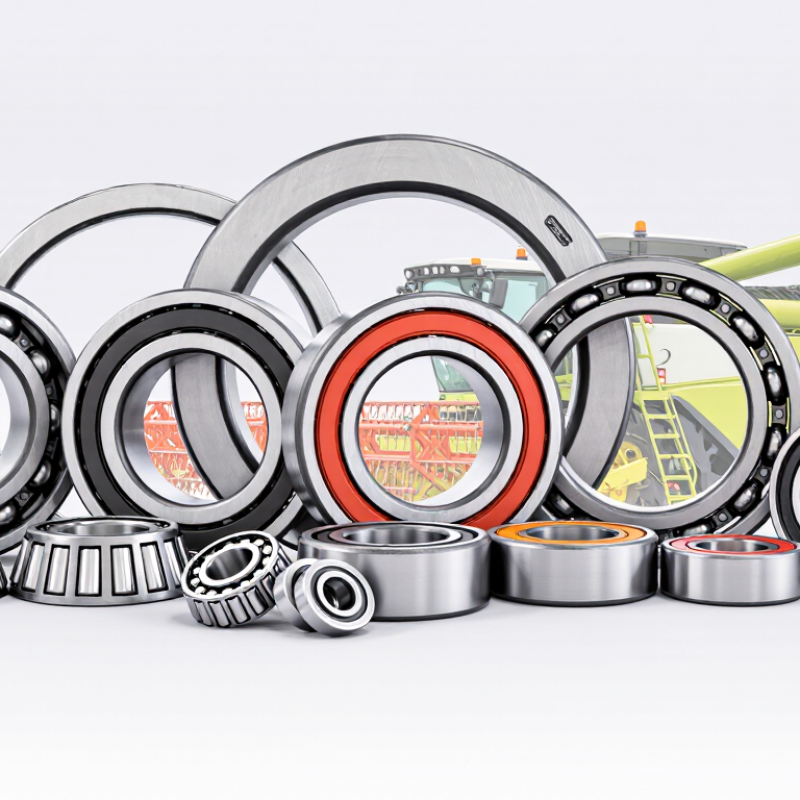
Top 10 Types of Agricultural Bearings for Global Buyers

Agricultural Bearings: Purpose, Design, and Selection Criteria

Agricultural bearings support rotating shafts in combines, planters, balers, irrigation systems, and grain conveyors. Common choices include deep-groove ball, spherical roller, tapered roller, needle, thrust, plain, flanged, insert, housed, and cross-roller bearings. Each design solves a different load problem. Ball bearings suit speed and moderate loads, while spherical rollers tolerate shaft misalignment. Tapered rollers manage combined radial and axial forces. Plain bearings can survive dirt better, but usually require careful lubrication.

Selection must begin with real field conditions, not catalogue habit. Measure radial load, axial load, speed, shaft size, shock, moisture, dust, and operating temperature. Sealing matters near soil and crop residue. Clearance also deserves attention because thermal expansion can create damaging preload.

FAO’s The State of Food and Agriculture 2022 reports that agrifood systems produced about 31% of global human-caused greenhouse gas emissions in 2020. Efficient, durable components can support lower maintenance waste, although bearing savings are rarely measured alone.

The OECD-FAO Agricultural Outlook 2024–2033 expects continued growth in global agricultural production and machinery demand. That increases pressure on bearing reliability. In practice, a slightly oversized bearing is not automatically safer. It may increase friction, housing stress, and cost.

Engineers should verify calculated life against contamination and shock data. Field inspection remains essential. Dust patterns often reveal poor sealing before failure appears.

Some selection decisions still rely on incomplete farm records, which is an uncomfortable weakness worth correcting.

Deep Groove and Angular Contact Bearings for Farm Machinery

Among the top 10 types of agricultural bearings, deep groove and angular contact bearings serve different working demands. Deep groove bearings handle radial loads and moderate axial loads with simple, reliable operation. They suit electric motors, conveyor rollers, seed drills, and many tractor attachments. Their compact design also makes replacement practical in dusty field conditions.

Angular contact bearings support combined radial and axial loads more effectively. They are useful in mower spindles, pumps, harvesting units, and rotating assemblies with changing thrust. Correct mounting matters. Contact angles must match the machine’s load direction and operating speed. Excessive preload can create heat, while loose fitting may cause vibration and uneven wear. I have seen a clean bearing fail early because the shaft seat was slightly damaged.

Field experience shows that contamination causes many avoidable failures. Check seals after washing equipment, and inspect grease for water, metal particles, or discoloration. Use the specified clearance and lubricant, not a convenient substitute. A bearing that feels rough should not return to service. Record operating hours, temperature changes, and replacement dates for dependable maintenance decisions. Still, inspection alone is imperfect; hidden misalignment can remain until harvest pressure exposes it.

Tapered Roller and Spherical Roller Bearings in Heavy-Duty Equipment

Agricultural machinery operates through dust, vibration, moisture, and uneven field surfaces. Bearings must survive these conditions while carrying changing loads. Tapered roller bearings support radial and axial forces together, making them suitable for wheel hubs, gearboxes, and heavily loaded drive assemblies. Their tapered raceways guide rollers into a stable contact pattern. Correct adjustment remains essential.

Spherical roller bearings are useful when shafts deflect or housings lose perfect alignment. They tolerate angular misalignment and absorb shock from rough ground, overloaded conveyors, and crop material buildup. Their self-aligning design can reduce edge stress on the rollers. Dust changes everything. Effective seals and suitable grease matter as much as the bearing rating.

In practical equipment inspections, technicians should check heat, noise, grease condition, and shaft play. A blue discoloration may indicate overheating, while pitted raceways often suggest contamination or poor lubrication. Tapered bearings need controlled preload; excessive tightness creates heat, but excessive clearance allows vibration. Spherical bearings still require accurate housing fits and regular relubrication. Fit matters. No selection is perfect. Field conditions vary, and catalog calculations may not reflect sudden impacts or neglected maintenance. Buyers should compare load ratings, sealing arrangements, operating speed, mounting space, and service access before choosing among the top agricultural bearing types.

Top 10 Types of Agricultural Bearings for Global Buyers

Representative dynamic load ratings for common agricultural bearing configurations

Spherical roller and tapered roller bearings generally provide higher load capacity for heavy-duty equipment such as combines, tractors, conveyors, and tillage machinery. The values shown are approximate representative catalog ratings in kN for common bearing configurations; actual performance varies by size, clearance, sealing, material, lubrication, and operating conditions.

Flange, Insert, and Pillow Block Bearings for Agricultural Systems

Top 10 Types of Agricultural Bearings for Global Buyers

Flange, insert, and pillow block bearings support many agricultural systems. Their best choice depends on load, contamination, shaft alignment, and service access. The OECD-FAO Agricultural Outlook 2024–2033 projects global agricultural and fish production to grow about 1.1% annually. That growth will increase pressure on conveyors, harvesters, feeders, and irrigation equipment.

Flange bearings suit compact assemblies where mounting space is limited. Their bolt pattern helps stabilize shafts near panels or machine frames. Insert bearings offer practical replacement because their locking collars or set screws simplify installation. Pillow block bearings carry rotating shafts above a base, often on conveyors and grain handling lines. They also allow easier inspection beside dusty belts. Fit matters.

Field inspections frequently find premature damage near seals, not rolling elements. Fine soil enters through damaged seals, while over-tightened fasteners distort housings. ISO 281 provides the standard method for calculating bearing rating life, but real farm life can be shorter. Shock loads, washdown water, and poor alignment change the result. The U.S. Department of Energy’s motor-system guidance also identifies misalignment and lubrication problems as major sources of mechanical loss. Dust changes everything.

Global buyers should compare dynamic load ratings, shaft tolerances, sealing structure, grease compatibility, and temperature limits. Insert and pillow block units need accessible grease points. Flange units need rigid mounting surfaces. A cheaper bearing may fit today, yet create longer downtime during harvest. That trade-off deserves careful review, especially when local replacement supply is uncertain.

Thrust, Needle, and Specialized Bearings for Farming Applications

Top 10 agricultural bearing types support demanding farm equipment across planting, harvesting, and material handling. The main options include deep-groove ball, angular-contact, tapered roller, cylindrical roller, spherical roller, thrust ball, tapered thrust, needle roller, spherical plain, and flanged bearings. Thrust bearings manage axial loads in vertical augers and gearbox assemblies. Needle bearings fit compact spaces, such as cutter-bar pivots and transmission joints. Specialized sealed bearings help resist dust, moisture, and crop residue.

FAO’s World Food and Agriculture Statistical Yearbook 2023 reports about 4.8 billion hectares of agricultural land globally. That scale increases pressure on reliable machinery. OECD-FAO Agricultural Outlook 2024–2033 also expects continued growth in global agricultural output. Bearing selection therefore needs practical testing, not only catalogue ratings. Check radial and axial loads, speed, misalignment, temperature, and washdown exposure. ISO 281 life calculations help, but contamination can reduce real service life sharply. A perfect selection is rare.

Tips: Match thrust capacity to the actual force direction. Use needle bearings where radial space is limited. Choose effective seals for muddy fields. Inspect grease condition and shaft wear during every planned service. I have seen oversized bearings fail early because poor alignment remained uncorrected. That detail is easy to miss.

LSP App

Download the LSP App now

Scan QR code to download the app

We use cookies to personalize content, utilize website traffic analytics & support our marketing initiatives. By continuing to browse our site you consent to receive our cookies. For more information see our Privacy Statement. 
Ok