China Top 10 Acoustic Panel Manufacturers?
Acoustic comfort is no longer a finishing detail in offices, schools, hotels, and studios. It affects speech clarity, concentration, and how a room feels during a long day. The European Environment Agency’s Environmental Noise in Europe 2020 report estimated that 113 million people were exposed to long-term road noise at or above 55 dB Lden. That figure describes environmental noise, not indoor reverberation. The distinction matters: Acoustic Panels can reduce reflected sound inside a room, but they do not automatically block traffic noise from outside.
China’s manufacturers serve projects ranging from compact meeting rooms to large auditoriums. Yet a polished product photo tells buyers very little. Absorption performance depends on the panel, its backing, thickness, spacing, and installation. ASTM C423 and ISO 354 provide recognized methods for measuring sound absorption, while fire performance, emissions documentation, and finish consistency also deserve scrutiny. Numbers need context. A high absorption rating alone does not prove that a panel suits every space.
This guide introduces ten Chinese manufacturers and offers a practical starting point for comparison. It considers product range, customization, production capability, export experience, and the clarity of technical documentation. These factors are more useful than treating any list as a definitive ranking. Supplier information can change, and impressive claims still need verification through current test reports, samples, and project references. A shortlist is not a verdict. For architects, contractors, and distributors, careful checks can help turn a promising catalogue into a dependable specification.
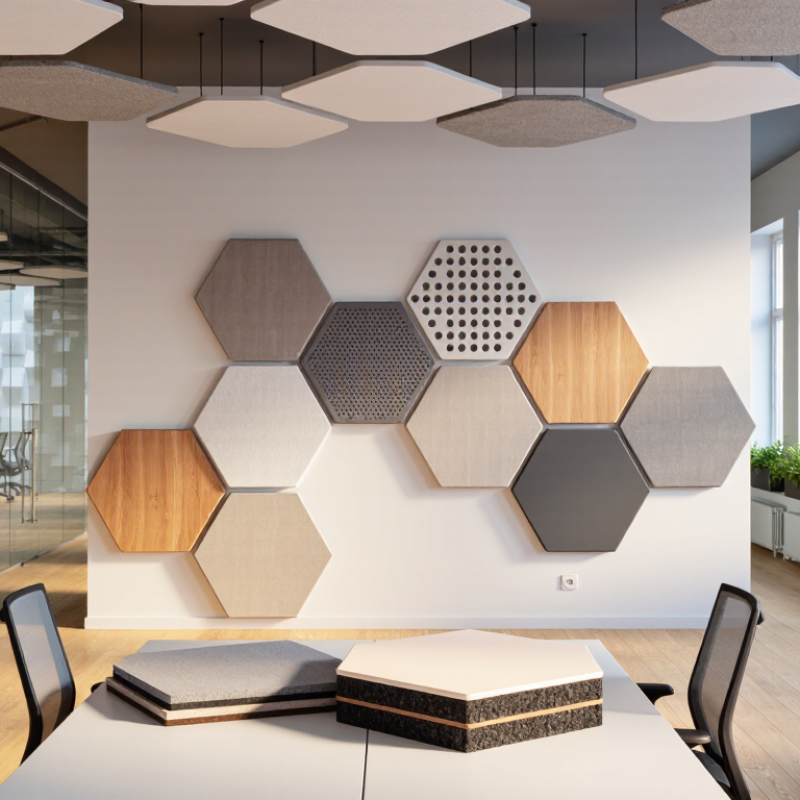
What Acoustic Panels Are and How They Improve Sound
What Acoustic Panels Are and How They Improve Sound
Acoustic panels are porous absorbers fitted to walls or ceilings. Their fibers or open-cell cores let sound energy enter, where friction converts some of it into heat. They reduce reflections and reverberation, making speech clearer in meeting rooms, classrooms, and restaurants. They do not block all sound from passing through walls. Not silence. A panel is not soundproofing.
The Noise Reduction Coefficient (NRC), measured under ASTM C423, summarizes sound absorption across selected frequencies on a scale from 0 to 1. Higher values generally indicate greater absorption, but performance varies by frequency and installation. ANSI/ASA S12.60 sets classroom reverberation-time limits of 0.6 seconds for certain smaller learning spaces and 0.7 seconds for larger ones. These are design benchmarks, not guaranteed results from adding panels. Room volume, furnishings, and panel placement all matter. A bare, echoing wall can still sound harsh after treatment if the ceiling and other surfaces remain reflective.
Tips: Clap near a hard wall and listen for a fluttering echo. Treat key reflection points, then reassess. Start with reflection points. Measure before and after when possible; the ear is useful, but imperfect.
China’s Acoustic Panel Industry and Its Main Product Types
China’s acoustic panel industry combines large-scale production with flexible customization for offices, schools, studios, hotels, and public interiors. Suppliers commonly offer panels in varied thicknesses, colors, edge shapes, and mounting systems. Production capacity can be substantial, yet finish consistency and test documentation still deserve careful review. A room tells a different story.
Common types include polyester-fiber panels, fabric-wrapped mineral-wool or fiberglass panels, perforated wood panels, and acoustic foam. Polyester fiber is lightweight and often chosen for classrooms or meeting rooms. Fabric-wrapped panels can provide strong mid- and high-frequency absorption when their core and air gap are specified correctly. Perforated wood adds a warm, durable surface, while foam is often used in controlled studio areas. They are not interchangeable.
Buyers should match panel type to the room’s actual problem. Echo in a bright conference room differs from noise passing through a wall; absorbers mainly reduce reflections, not sound transmission. Ask for independent acoustic test results, fire-performance details, dimensions, and installation guidance. Samples help reveal texture and color, but they cannot prove installed performance. I would still leave room for a small trial area. Real rooms surprise people.
China’s Acoustic Panel Industry: Typical NRC Ranges by Product Type
Illustrative sound-absorption ranges for common panel types—not a manufacturer ranking. Actual performance depends on thickness, backing, mounting, and test conditions.
NRC is a rounded average of sound-absorption coefficients measured at 250, 500, 1,000, and 2,000 Hz. Values shown are indicative product-category ranges; check laboratory test reports for specific products.
How to Assess Acoustic Panel Manufacturers in China
Assessing an acoustic panel manufacturer in China starts with the product, not the sales presentation. Ask for recent test reports that match the panel’s thickness, finish, and installation method. A result from a different assembly may not predict performance in your room. Check whether reports identify the testing laboratory, sample details, and measurement conditions. Small details matter.
Request a sample and inspect its edges, surface consistency, backing, and packaging. Then compare it with the production specification, not just a carefully prepared showroom piece. Ask how the factory checks material batches, dimensions, and finish defects. For projects with specific fire or environmental requirements, request relevant documentation and confirm that it covers the exact product offered. Visit the facility if practical, or arrange an independent inspection before shipment. Lead times and minimum order quantities deserve the same scrutiny as price.
Good communication helps, but it is not proof of quality. A clear answer about tolerances is more useful than a broad promise of “premium” production. I would still treat one sample cautiously: it cannot reveal every batch variation. Some buyers focus heavily on acoustic ratings and overlook installation support. That can be an expensive gap.
Profiles of Ten Leading Acoustic Panel Manufacturers in China
China’s acoustic-panel industry includes manufacturers with different materials, production scales, and project strengths. These ten profiles focus on capabilities rather than company names or a fixed ranking. Actual suitability depends on room use, fire-performance requirements, budget, and verified product documentation.
One profile centers on PET felt panels, often cut into geometric shapes for offices and classrooms. Another specializes in perforated wood, where hole patterns and backing materials affect sound absorption. A third produces fabric-wrapped glass-fiber panels for meeting rooms. A mineral-wool specialist may offer a broad range of thicknesses. Then there are workshops with CNC equipment for custom dimensions and edge details.
Small details matter.
Other manufacturers build panels from recycled fibers, while some focus on modular systems that simplify replacement. An export-oriented producer may provide clearer packing lists and technical sheets, but buyers should still check test reports. Another profile emphasizes project coordination, matching panel layouts to ceilings, walls, and installation schedules. The final type handles small custom batches for unusual spaces. Useful, but not always inexpensive.
Production photos can help, yet they do not replace samples or independent performance data. Ask about color consistency, edge finishing, lead times, and packaging protection. A careful comparison may reveal gaps: product descriptions can sound precise while leaving installation conditions unclear.
That deserves a closer look.
Comparing Their Materials, Certifications, and Export Capabilities
China Top 10 Acoustic Panel Manufacturers?
Comparing China’s top ten acoustic panel manufacturers is more useful when treated as a sourcing shortlist, not a fixed ranking. Materials shape both performance and upkeep. PET panels are lightweight and easy to cut; mineral-wool panels often need durable edge protection. Wood-wool and fabric-wrapped options can suit different interiors, but their acoustic results depend on thickness, backing, and installation. Ask for test data on the exact panel, not just a general product sheet.
Certifications deserve careful checking. Request current documents and confirm which product, factory, and test method each one covers. Fire-performance and emissions reports matter for many projects, while quality-management certificates describe a company’s processes, not every panel’s performance. Export capability is practical, too: ask about sample lead times, protective packaging, carton dimensions, shipping documents, and support for replacement orders. A polished catalogue is not proof of reliable delivery. I would still verify claims against project requirements; a comparison spreadsheet can make uncertain details look more certain than they are.
Tips: Request one physical sample and its matching test report. Check that the finish, core, and thickness match the quoted specification. Clarify how panels are packed before comparing freight costs. Small details matter.

 Skip to main content