What Are the 2026 Best Folding Glass Doors? The answer depends on how a home or commercial space is used. A coastal house needs corrosion-resistant hardware, while a city apartment may prioritize noise control and compact operation. In this guide, we examine Folding Glass Doors through practical performance, not attractive photographs alone.
The strongest 2026 options should combine slim profiles, reliable folding panels, and high-performance glazing. Look for smooth rollers that remain quiet after repeated use. Check the frame’s thermal break, weather seals, drainage design, and glass specification. These details matter when rain strikes the threshold or afternoon heat reaches a south-facing room. Low-maintenance finishes also help, especially in busy kitchens, restaurants, and family rooms.
Safety deserves equal attention. Quality systems should include secure locking points, properly treated safety glass, and installation instructions from established manufacturers. Professional measurement is essential because a small opening error can affect alignment, sealing, and long-term movement. Still, no folding door performs perfectly in every climate. Large glass panels can increase heat gain, fingerprints appear quickly, and premium hardware often raises the project budget.
That is the honest trade-off.
Our comparison considers verified specifications, installer experience, warranty coverage, and real maintenance demands. We also question impressive claims when testing details are unclear. The best choice may not be the widest system or the thinnest frame. It may be the door that opens smoothly, stays dry, and performs consistently for years.
What Defines a High-Quality Folding Glass Door in 2026
A high-quality folding glass door should combine clear views, smooth movement, and dependable insulation. In real installations, poor alignment causes most daily frustration. Each panel should fold evenly, without scraping the track or requiring force. Strong rollers and corrosion-resistant hardware matter, especially near humid areas.
Energy performance now deserves close attention. Look for low-emissivity glass, insulated frames, and continuous weather seals. These features help reduce drafts and indoor temperature swings. Laminated or tempered glass improves safety and durability. However, thicker glass alone does not guarantee quality. The frame, drainage system, and installation method also influence long-term performance. No folding door is perfect. Even excellent systems may need seasonal adjustment.
Tips: Open every panel before purchasing. Check the handle height, threshold, locking points, and drainage openings. Ask for tested air, water, and wind ratings. Review the installation warranty carefully. A showroom sample can look flawless, yet reveal little about performance after years of use. Record the opening width and floor level before ordering. Small measurement errors can create expensive problems. Choose trained installers who explain maintenance clearly, including track cleaning and seal inspection. A reliable door should feel stable, quiet, and controlled during everyday use.
What Are the 2026 Best Folding Glass Doors?
Modern folding glass doors should be compared by performance, not panel count. ENERGY STAR reports that windows can cause 25–30% of a home’s heating and cooling energy use. Therefore, check the NFRC-certified U-factor and solar heat gain coefficient (SHGC). Lower U-factor improves insulation. SHGC should match the climate and window orientation. A sunny west-facing opening may need stronger solar control. Clear glass alone can create afternoon glare and uncomfortable heat.
Frame design matters too. Thermal breaks reduce conductive heat transfer through aluminum profiles. Multi-point locks improve compression and security. Reliable rollers should move smoothly across a level track, even with wide panels. Ask for tested air leakage, water resistance, and structural performance data. The 2024 International Energy Conservation Code also emphasizes whole-opening efficiency, not glass performance alone. Installation can weaken excellent specifications. Sadly, this is often underestimated.
Tips: Request the complete NFRC label and independent test results. Examine the sill after simulated rain testing, if available. Confirm the glass is safety-rated where required. Leave space for drainage and maintenance access. A perfect folding door rarely exists. Prioritize the features your climate truly needs, then inspect the installation details carefully.
Key thermal feature to compare: representative whole-door U-factor by glazing configuration. Lower values indicate better insulation and reduced heat transfer.
The values are representative performance figures for common modern glazing configurations, expressed in W/m²·K. Actual results vary with frame material, panel size, spacers, seals, and testing standards.
The best folding glass doors for 2026 balance materials, design, and opening systems. Thermally broken aluminum offers slim sightlines and strong weather resistance. Fiberglass frames provide lower maintenance and stable performance. Wood-clad systems add warmth, but they need regular finishing. Low-emissivity, double-glazed glass can improve comfort and reduce heat transfer. The U.S. Department of Energy estimates that windows may cause 25–30% of residential heating and cooling energy use. That figure makes glass selection more important than frame appearance alone.
Design trends favor wide openings, corner configurations, and panels that stack neatly beside a wall. Top-hung systems usually roll more smoothly because the floor track carries less weight. However, they require strong structural support above the opening. Bottom-rolling systems can simplify installation, but their tracks need careful drainage and cleaning. The 2024 AIA Home Design Trends Survey continues to identify indoor-outdoor connections as a strong residential priority. Still, the thinnest frame is not always the best frame. Poor seals can ruin an attractive design.
Tips: Check the NFRC-rated U-factor and solar heat gain coefficient before ordering. Confirm the rough opening, drainage path, wind exposure, and panel storage area. Ask for a tested air-infiltration rating. I once underestimated stacking space on a renovation, and the door opened correctly but blocked the main walkway. Measure furniture paths, not only wall dimensions.
| Door Type | Primary Material | Typical Design | Opening System | Best Use | Main Advantages | Key Considerations |
|---|---|---|---|---|---|---|
| Thermally Broken Aluminum | Powder-coated aluminum frames with a polyamide thermal barrier | Large glazed panels with slim sightlines and minimal visual framing | Top-hung or floor-supported folding leaves connected by hinges and carrier rollers | Exterior openings, patios, balconies, and climates with temperature variation | Low maintenance, corrosion resistance, strong frame-to-weight ratio, and improved thermal performance | Thermal performance depends on the glass, seals, frame depth, and installation quality |
| Standard Aluminum | Extruded aluminum, usually anodized or powder-coated | Practical framed panels in a wide range of colors and configurations | Bottom-rolling or top-hung folding hardware | Mild climates, interior partitions, sunrooms, and moderate-size openings | Lightweight, durable, widely available, and easy to clean | Less insulating than thermally broken aluminum; metal may transmit heat and cold |
| Engineered Timber | Multilayer laminated wood with protective paint, stain, or aluminum cladding | Warm interior profiles with traditional, contemporary, or heritage detailing | Multi-panel folding arrangement with concealed or surface-mounted hinges | Residential interiors, period-style properties, and design-led living spaces | Natural appearance, good insulation potential, and a comfortable tactile finish | Requires coating maintenance and careful moisture management, especially on exterior faces |
| Aluminum-Clad Timber | Timber interior with a weather-resistant aluminum exterior shell | Two-sided design combining a natural indoor finish with a modern exterior profile | Top-hung or floor-supported folding system, depending on panel size | High-performance homes and projects needing both aesthetics and weather protection | Improved exterior durability, good thermal potential, and flexible interior styling | Generally heavier and more expensive than basic aluminum or timber systems |
| uPVC | Multi-chamber rigid uPVC profiles reinforced where required | Wider framed panels with practical proportions and multiple glazing options | Usually floor-supported with folding hinges and roller carriages | Budget-conscious residential projects and areas requiring low maintenance | Good resistance to moisture, simple upkeep, and potentially strong thermal insulation | Bulkier sightlines, lower rigidity for very large panels, and limited color stability in some finishes |
| Composite Frame | Combination of materials such as aluminum, timber, fiberglass, or reinforced polymer | Performance-focused frames designed to balance insulation, strength, and appearance | Configuration varies; top-hung and bottom-rolling layouts are both used | Energy-conscious renovations and large glazed openings with demanding specifications | Can combine structural strength, low maintenance, and improved thermal performance | System performance varies significantly; compare verified thermal and air-tightness data |
| Double-Glazed Folding Door | Any compatible frame material with two panes separated by a sealed insulating cavity | Balanced configuration for daylight, thermal control, and everyday residential use | Inward-opening, outward-opening, or split-stacking folding leaves | Most homes, interior-exterior connections, and moderate energy-efficiency targets | Better insulation and sound reduction than single glazing with manageable panel weight | Performance depends on cavity width, gas fill, low-emissivity coating, spacer, and frame |
| Triple-Glazed Folding Door | Compatible frame with three panes and two insulating cavities | High-performance panels with enhanced acoustic and thermal specifications | Usually floor-supported because the glazing units are heavier | Cold climates, passive-house-oriented projects, and high-noise locations | Lower heat loss and potentially better sound insulation than double glazing | Greater weight, deeper frames, higher cost, and increased demands on hardware alignment |
| Low-E Solar-Control Glass | Coated insulating glass used with aluminum, timber, composite, or uPVC frames | Clear or lightly tinted glazing selected to manage solar gain and glare | Compatible with most folding configurations when weight limits are observed | Sunny elevations, west-facing rooms, and spaces prone to overheating | Helps reduce heat transfer and solar gain while preserving natural daylight | Glass selection should reflect orientation, shading, climate, and desired daylight level |
| Laminated Safety Glass | Two or more glass layers bonded with a transparent interlayer | Safety-focused glazing that remains more securely held after breakage | Available in inward, outward, and centrally stacking folding systems | Doors at floor level, family areas, public spaces, and locations needing security | Improves impact safety and can provide additional acoustic and ultraviolet filtering benefits | Heavier than ordinary annealed glass; local safety requirements should guide specification |
| Top-Hung Folding System | Frame material varies; operating load is carried mainly by an overhead track | Clean floor line with minimal or no rolling track across the sill | Panels are suspended from upper carriers and fold to one or both sides | Accessible thresholds, interior partitions, and areas where floor tracks are undesirable | Smoother floor transitions, easier cleaning at the threshold, and reduced trip risk | Requires a structurally adequate head beam and precise installation of the upper track |
| Bottom-Rolling Folding System | Frame material varies; rollers carry the panel weight at the sill | Robust multi-panel layout suitable for large or heavier glazed leaves | Roller carriages travel along a sill track while hinges fold the panels together | Large exterior openings and installations where overhead structural support is limited | Handles substantial panel loads without relying primarily on the head structure | Track drainage, cleaning, weather sealing, and threshold height require careful attention |
| Traffic Door Configuration | Any suitable frame and safety-glazing combination | One active leaf opens independently while the remaining leaves stay folded | Single access leaf integrated into a bi-fold or multi-fold arrangement | Kitchens, patios, restaurants, and frequently used daily access routes | Allows quick passage without opening the entire wall of glass | Needs durable hinges, a reliable latch, and a clear indication of the active leaf |
| Split-Stacking Design | Aluminum, timber, composite, uPVC, or mixed-material frames | Panels fold into groups on both sides of the opening | Central opening with paired folding leaves that stack left and right | Wide symmetrical openings and rooms requiring a centered access route | Balances panel weight, reduces stack depth at each side, and creates a broad central opening | Requires accurate coordination of panel count, hinge direction, and hardware clearances |
| Exterior-Stacking Design | Weather-resistant frame and insulating safety glass | All leaves fold toward one side of the opening, inside or outside the room | One-direction folding with a designated parking area for the stacked leaves | Asymmetrical rooms, compact wall layouts, and openings with one clear side | Simple operating pattern and flexible placement of the panel stack | Check stack width, furniture clearance, wind exposure, and the direction of operation |
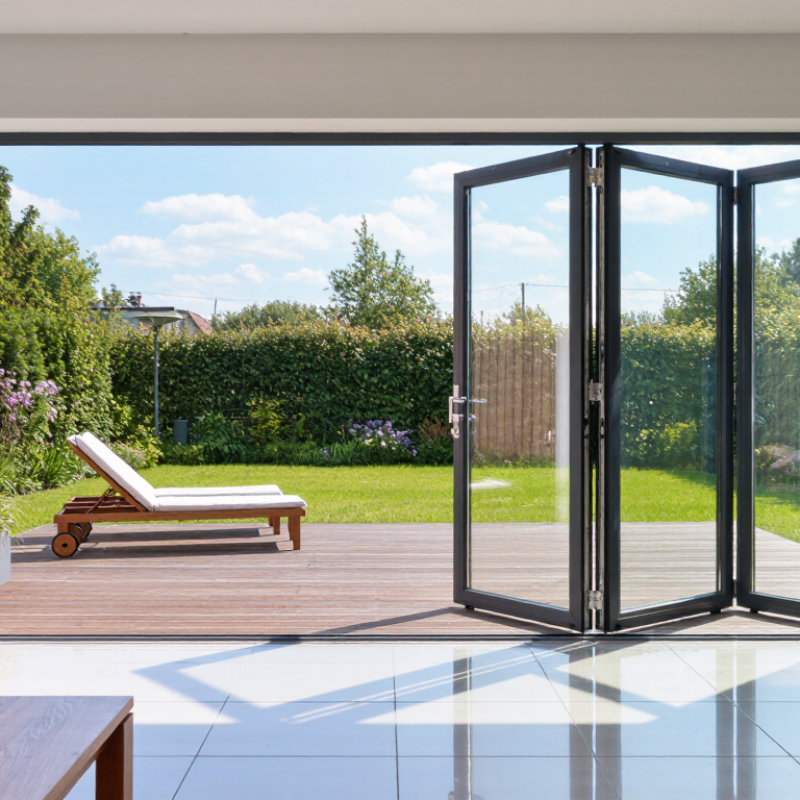
| Selection note: The most suitable folding glass door depends on opening width, panel weight, thermal requirements, safety-glazing rules, threshold accessibility, wind exposure, drainage, and the structural capacity of the head or sill. | ||||||
What Are the 2026 Best Folding Glass Doors?
Choosing the best folding glass doors in 2026 starts with climate, not appearance. In cold regions, thermally broken frames and low-emissivity glazing reduce indoor heat loss. Hot climates may need glass with a lower solar heat-gain coefficient. Ask for tested U-factor and air-infiltration data. Marketing claims are not enough. Large openings expose weak installation quickly. I have seen comfortable rooms become drafty after poor head-track alignment.
Security requires more than a strong handle. Look for laminated or impact-rated glass, reinforced panels, multipoint locks, and anti-lift hardware. The sill should drain water safely. Gaskets must remain continuous around every folding joint. A low threshold improves access, but it can complicate drainage. Small gaps matter. Have an installer check anchoring and lock engagement after adjustment. Independent testing adds confidence, although certificates cannot replace a site inspection.
Durability depends on daily movement and local exposure. Stainless or treated hardware usually performs better near coastal air. Rollers should carry panel weight without binding. Check whether replacement seals and rollers will remain available for years. Annual inspections can catch worn gaskets, loose fasteners, and track debris. I would not claim any door is maintenance-free. That promise often fails at the threshold. RTWF
Choosing the best folding glass door for your space starts with how you live, not with appearance alone.
Measure the opening, wall depth, and nearby furniture carefully. Leave enough clearance for panels to stack without blocking a walkway. A narrow terrace may need an outward-stacking layout, while a wide living room can suit a central opening. Think about daily use.
For 2026 strong choices should balance insulation, smooth movement, and weather resistance. Look for low thermal transmission, reliable seals, and drainage channels suited to your climate.
In coastal areas, corrosion-resistant hardware matters. In colder regions, a well-insulated frame can reduce cold spots near the floor. Ask for tested air, water, and structural performance. Small details matter.
Safety glazing is essential for large panels, and the threshold should support easy access without inviting water inside. Confirm that the installation follows local building requirements.
Installation quality can decide whether an expensive door performs well. The frame must be level, square, and securely anchored before the panels are adjusted. I have seen beautiful systems fail because the floor was slightly uneven. That mistake is easy to underestimate.
Choose a qualified installer, then inspect the rollers, seals, locks, and drainage after fitting. A softer closing action may seem minor, but it can protect the hardware over time.
The best door may not be the widest one. It may simply fit your room, climate, and routine better.
Scan QR code to download the app
LSP Products was founded by plumbers over 50 years ago with a focus on unparalleled innovation, superior product quality, and best-in-class service to the plumbing industry. Our primary focus is the new construction market where we develop products that make installations easy and provide significant cost savings to the plumbing/mechanical contractor. LSP has a manufacturing facility located in Monterrey, Mexico and a distribution center in Dallas, Texas. We are proud to offer many products designed and made in North America… About LSP
Submit the form below to receive the document via email.