How to Choose the Right Material Handling Equipment
Choosing the right Material Handling Equipment can shape safety, throughput, labor costs, and customer service. A forklift that suits one warehouse may fail in another. A narrow aisle, uneven floor, or fragile pallet changes the decision.
MHI’s 2024 Annual Industry Report found that 39% of surveyed companies currently use robotics and automation. That figure may reach 69% within five years. The report also showed expected growth in artificial intelligence adoption, from 26% to 74%. These figures suggest strong investment. They do not prove that every business needs automation.
John Paxton, President and CEO of MHI, has said, “The right technology, implemented at the right time, can help companies build resilient supply chains.” His point deserves practical attention. Equipment selection should begin with measurable work conditions, not impressive brochures. Record pallet weights, travel distances, aisle widths, floor quality, charging access, and operator experience. Then compare forklifts, conveyors, pallet trucks, stackers, storage systems, and automated solutions against those facts.
Small details matter.
A battery may last through one shift but fail during seasonal peaks. A conveyor may reduce walking but create a difficult maintenance point. Automation may improve consistency, yet it can also demand stronger data, training, and technical support. These trade-offs are easy to underestimate.
This guide explains how to assess capacity, safety, ergonomics, energy use, maintenance, integration, and total cost of ownership. It also encourages review after installation. The first choice is not always the final answer. Real operating data should have the last word.
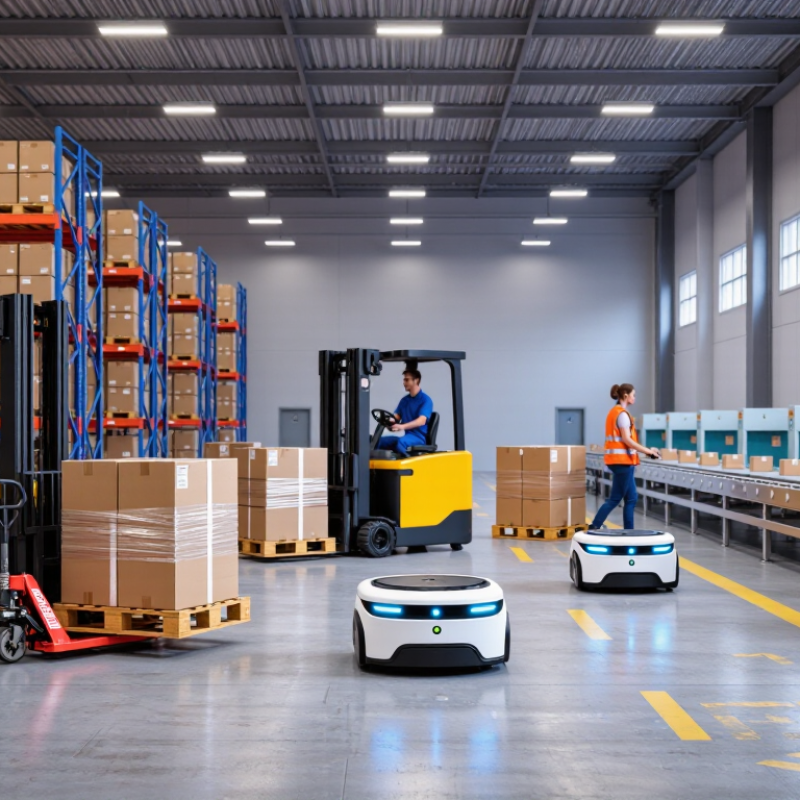
Define Load, Throughput, Travel Distance, and Duty Cycle
Choosing material handling equipment begins with four measurable conditions: load, throughput, travel distance, and duty cycle. Record the heaviest unit load, not the average carton. Include pallets, packaging, attachments, and uneven weight distribution. A 1,000-kilogram load may require more capacity when its center of gravity shifts. In real warehouses, operators often underestimate this detail. That mistake is expensive.
Throughput means completed moves per hour, including waiting, loading, unloading, and battery changes. Measure peak-hour demand, not only daily averages. MHI’s 2024 Annual Industry Report found that 83% of respondents planned to increase supply chain technology and innovation investment. Better measurement should come first. Travel distance also changes the equipment choice. Map the actual route, including turns, ramps, doorways, and pedestrian controls. A short route with congestion can demand more performance than a longer, clear aisle. Duty cycle captures hours per shift, starts, stops, lifts, and recovery time. Occasional-use equipment may fail under repeated peaks.
Tips: Build a one-week observation sheet. Log load weight, moves per hour, route length, idle minutes, and charging time. Compare the busiest 15-minute interval with the shift average. Ask maintenance staff what fails first. Their experience may challenge the spreadsheet. Mine often does. Leave capacity margin, but avoid buying maximum capacity blindly. Oversized equipment can reduce aisle space and visibility. The U.S. Bureau of Labor Statistics reported 5,283 fatal work injuries in 2023, reinforcing the need to specify safe speed, visibility, and operator conditions.
How to Choose the Right Material Handling Equipment
Define the required load, throughput, travel distance, and duty cycle before selecting equipment. The chart compares a representative warehouse requirement with practical planning reference levels.
Example requirement: 1,500 kg load capacity, 40 pallet moves per hour, 300 m average travel distance, and 8 operating hours per day. These values are normalized against planning references of 2,000 kg, 60 pallet moves per hour, 500 m, and 10 hours per day. Confirm final specifications with site measurements and equipment documentation.
Design Around 48 × 40-Inch Pallets and Rated Load Capacity
Choosing material handling equipment starts with the pallet, not the machine. In North American warehouses, the 48 × 40-inch pallet remains a practical planning baseline. Measure its actual length, width, height, and entry direction before selecting forks, conveyors, racks, or lift tables. A few inches matter near rack beams and trailer walls. Tight clearances create costly hesitation.
Rated load capacity deserves equal attention. Calculate the pallet, product, packaging, and uneven weight distribution together. Then add a sensible operating margin. Never treat the equipment’s maximum rating as a daily target. The capacity may change with lift height, load center, attachment use, or mast position. ANSI/ITSDF B56.1 requires capacity information to remain visible on applicable powered industrial trucks. Check the plate during inspections. Do not rely on memory.
The 2024 MHI Annual Industry Report found that 83% of respondents planned to increase technology and innovation investment within five years. Automation may improve consistency, but it cannot correct poor pallet data. I have seen layouts designed around an “average” load that failed during peak season. That assumption was convenient, not reliable. Recheck pallet dimensions against real shipments, especially damaged or overhanging loads. Document the calculation, test the equipment gradually, and ask operators what the drawings missed. Field experience often exposes the flaw.
Compare Manual, Powered, and Automated Options by Throughput
Choosing material handling equipment starts with throughput, not appearance. Measure units per hour, order lines, travel distance, and peak demand. A manual cart may suit 40 cartons per hour across a short aisle. It becomes a bottleneck when workers repeat long walks or handle heavy loads.
Powered equipment raises consistency. Electric pallet trucks and lift equipment can support higher volumes with less physical strain. However, battery charging, aisle width, operator training, and maintenance affect real output. The 2024 MHI Annual Industry Report reported that 43% of supply chain organizations already use robotics and automation. It also found that 88% expected adoption within five years. Adoption is rising.
Automation fits stable, repetitive flows. Conveyors, sortation systems, and mobile robots can operate continuously and provide measurable cycle times. The International Federation of Robotics reported 541,302 industrial robots were installed worldwide in 2023. That figure is not warehouse-specific, but it signals broader investment in automated productivity. Yet automation is not automatically faster. Poor layout, uneven order profiles, or inaccurate inventory data can reduce throughput. I have seen simple manual staging outperform complex systems during short seasonal peaks. That result was uncomfortable, but useful. Compare hourly output during normal and peak periods, then include labor, downtime, integration, and recovery time. A smaller powered solution may outperform an expensive automated line when demand remains variable.
Verify Forklift Training Every 3 Years Under OSHA 1910.178(l)
Choosing material handling equipment begins with the load, aisle width, floor condition, and lifting height. A forklift may look suitable on paper, yet fail in a crowded warehouse. I have seen operators struggle when turning space was measured too generously. Small details matter.
OSHA 1910.178(l) requires employers to train powered industrial truck operators properly. Employers must also evaluate each operator’s performance at least once every three years. This is not simply a paperwork deadline. A supervisor should observe braking, load positioning, steering, visibility checks, and travel speed. Record the evaluator, date, equipment type, and observed skills. Keep records accessible.
Three years can pass quickly. Training must also be repeated when an operator drives unsafely, is involved in an accident or near miss, operates a different truck, or faces workplace changes. New rack layouts and uneven floors deserve attention. So do attachments and unusual loads. Refresher training may be necessary before the next scheduled evaluation. That judgment requires care.
A practical verification process compares the training record with the actual equipment and work area. Ask whether the operator can explain capacity limits and identify damaged components. Do not assume experience equals competence. I once treated a familiar route as low risk; a wet corner proved otherwise. The better choice may be a different truck, a slower process, or more supervision. Mistakes in selection and verification should be reviewed honestly, not hidden.
 Skip to main content