How to Choose the Best Noise Insulation Foam?

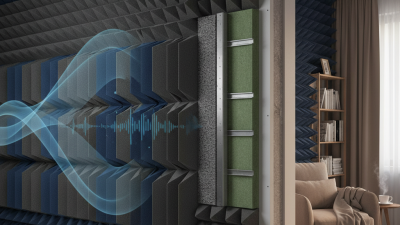
Choosing the best noise insulation foam starts with identifying the noise you want to control. Room echo, voices, and machinery can require different treatments. Foam often absorbs sound within a room; it does not automatically block sound passing through walls. That distinction matters.

The World Health Organization’s Environmental Noise Guidelines for the European Region (2018) recommend keeping average road-traffic noise below 53 dB Lden and nighttime levels below 45 dB Lnight. These figures describe public-health exposure, not a foam product’s performance. Still, they show why noise control deserves careful attention. The WHO’s 2011 Burden of Disease report also estimated that environmental noise caused at least one million healthy life years lost annually in Western Europe. Numbers help, but they do not select a panel for you.

When comparing noise insulation foam, check its intended use, thickness, density, fire-safety documentation, and installation requirements. Look for absorption data tested using recognized methods, such as ASTM C423 or ISO 354, rather than relying on vague claims like “soundproof.” Results depend on the full assembly, room, and frequency range. A thin tile may tame a sharp echo, yet do little for bass or noise traveling through a door gap. Fit matters. This guide explains how to match foam to the problem, interpret product data, and avoid paying for performance you may not need. There is no perfect panel for every room, and product labels can be confusing; verify the details before buying.
How to Choose the Best Noise Insulation Foam?

Define the Goal: Sound Absorption (NRC) or Sound Isolation (STC)

Before buying noise insulation foam, decide what problem you are solving: echo inside a room or sound passing through a wall. These are different jobs.

Sound absorption is described by the Noise Reduction Coefficient, or NRC. It indicates how much sound a material absorbs, not how much it blocks from reaching the next room. ASTM C423 calculates NRC from absorption measurements at 250, 500, 1,000, and 2,000 Hz, rounded to the nearest 0.05.

Foam on a bare wall may reduce a sharp clap’s lingering echo. It will not reliably stop bass from a neighboring room.

Sound isolation is commonly rated with Sound Transmission Class, or STC. ASTM E90 measures sound transmission through a tested wall or assembly; ASTM E413 assigns the STC rating.

The assembly matters. Studs, gaps, doors, and installation can all affect performance, so a foam product’s NRC cannot stand in for a wall’s STC test. Check the test report for the exact construction and frequency range.

Small gaps count. Even this distinction is imperfect: real rooms contain flanking paths and low-frequency noise that a single rating may not describe well.

Choose absorption foam for room reverberation; seek tested wall-system data when transmission is the concern.
Compare Foam Using ASTM C423 NRC Ratings and Frequency-Band Data

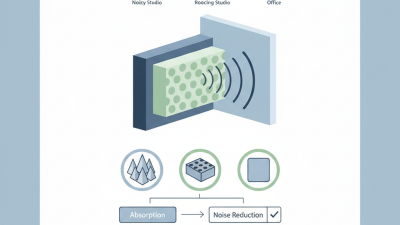
When comparing noise insulation foam, treat its ASTM C423 NRC rating as a starting point, not a promise. The test measures sound absorption in a reverberation room. NRC averages absorption at 250, 500, 1,000, and 2,000 Hz, then rounds the result to the nearest 0.05. A higher number can mean less reflected sound in those bands. It does not show how well foam blocks sound passing through a wall.

Check the frequency-band data beside the NRC. A panel may absorb midrange speech well but perform less strongly with a low hum from a fan. Look for the absorption coefficient at each listed frequency, not only one headline number. Test conditions matter, too. Foam thickness, mounting method, and any air gap behind the panel can change results.

Small details matter. A thin sample fixed directly to a hard surface may behave differently from a thicker panel with space behind it. In a room with sharp echoes, mid- and high-frequency absorption may help. For bass, the same foam might disappoint. That is easy to overlook. Compare test reports using similar setups, and check whether the frequency range matches the noise you actually hear. Even careful ratings cannot fully predict a particular room; furniture, windows, and placement complicate things. I would not choose from NRC alone.

Choose Thickness for Target Frequencies, from 125 to 4,000 Hz

How to Choose the Best Noise Insulation Foam?

Choose thickness according to the frequencies you want to reduce, not appearance alone. Foam typically absorbs sound inside a room; it does not reliably block noise passing through walls. Check test data for absorption at 125, 250, 500, 1,000, 2,000, and 4,000 Hz. A single overall rating can hide weak performance at lower frequencies. That detail matters.

At 125 Hz, sound waves are long, so thin foam usually has little effect. Deeper foam, sometimes installed with an air gap, can improve low-frequency absorption, but practical panels cannot absorb every bass note. At 1,000–4,000 Hz, thinner foam often performs better because the wavelengths are shorter. Match the material’s tested thickness and mounting method to your target range. Measure the room first; a small untreated corner can still cause noticeable reflections.

Tips: For a voice-heavy room, compare results around 500–2,000 Hz. For low hum, inspect 125–250 Hz data and consider thicker treatment. Test one panel before covering a whole wall. It may not behave as expected. Foam placement, room shape, and nearby hard surfaces all affect results, so adjust after listening.

How to Choose the Best Noise Insulation Foam? — Choose Thickness for Target Frequencies, from 125 to 4,000 Hz

Use this guide to compare how foam thickness affects sound absorption. Values are indicative absorption-coefficient ranges for typical open-cell acoustic polyurethane foam mounted directly on a rigid wall; they are not guaranteed product ratings.

Target Frequency 25 mm (1 in) 50 mm (2 in) 75 mm (3 in) 100 mm (4 in) Practical Thickness Choice
125 Hz — deep bass 0.02–0.05 0.05–0.10 0.10–0.20 0.15–0.30 Use 100 mm or more; a thick porous absorber or a purpose-designed bass trap is generally more effective.
250 Hz — bass 0.05–0.12 0.15–0.30 0.25–0.45 0.35–0.60 Choose 75–100 mm for improved absorption; thinner foam mainly affects higher frequencies.
500 Hz — low midrange 0.15–0.30 0.35–0.60 0.50–0.75 0.65–0.85 Choose 50–100 mm, depending on how much low-midrange control is needed.
1,000 Hz — midrange 0.35–0.60 0.65–0.90 0.80–1.00 0.85–1.00 Choose 50 mm or thicker for substantial midrange absorption.
2,000 Hz — upper midrange 0.60–0.85 0.80–1.00 0.85–1.00 0.90–1.00 25–50 mm is often effective for this range; thicker material also addresses lower frequencies.
4,000 Hz — high frequency 0.75–0.95 0.85–1.00 0.90–1.00 0.90–1.00 25 mm can absorb much of this range; increasing thickness generally provides less additional benefit here.

Absorption coefficients describe sound absorbed within a room, not sound blocked from passing through a wall. Actual performance varies with foam formulation, density, mounting, air gap, and test method. For verified comparisons, check frequency-by-frequency results from an independent laboratory test, such as ASTM E1050 or ISO 10534-2.

Check Fire and VOC Ratings Against Applicable Building Codes

How to Choose the Best Noise Insulation Foam?

Check Fire and VOC Ratings Against Applicable Building Codes

A foam panel’s acoustic performance is only part of the decision. Check its fire-test documentation against the codes adopted for your building and the room’s use. ASTM E84 and UL 723 measure surface flame spread and smoke development; they do not, by themselves, establish that every installed wall assembly complies. Facings, adhesives, cavities, and protective layers can change the result. A rating label can look reassuring. It is not the whole assembly.

Review VOC emissions data, too. The US Environmental Protection Agency reports that concentrations of many VOCs are often higher indoors than outdoors, sometimes two to five times higher. Ask for chamber-test results and confirm which test method and installation conditions they represent. Compare results with applicable project requirements, such as California’s CDPH Standard Method, where relevant. Odor is not a reliable emissions test; a faint smell does not prove a product is safe or unsafe.

Tips: Match the exact product and facing to the report, then ask your code official or design professional to verify the proposed assembly. Keep the documentation. A small detail, like exposed foam around a socket, may deserve another look.

Verify Test Reports: ASTM C423 for Absorption and ASTM E90 for Transmission Loss

How to Choose the Best Noise Insulation Foam?

Noise insulation foam can absorb reflections inside a room, but absorption is not the same as blocking sound between rooms. Start by checking independent test reports, not just broad claims like “high performance.” ASTM C423 measures sound absorption in a reverberation room. Its results show how much sound a tested sample absorbs across different frequencies. The NRC is useful, but it can hide weak performance at particular pitches. Details matter.

ASTM E90 measures airborne sound transmission loss through a tested partition or assembly under laboratory conditions. It does not automatically prove that a sheet of foam will block noise on its own. Read the setup. Check whether the report covers the foam alone or a complete wall, including its framing and other layers. Compare the tested thickness, mounting method, and frequency data with the product you are considering.

A report is only useful when the sample resembles your intended installation. A thick sample mounted with an air gap may perform differently from thin foam attached directly to a door. Ask for the full report, test date, and sample description. If only a single rating appears, request frequency-by-frequency results. Small gaps around edges can also undermine an otherwise sound assembly. Lab numbers guide a choice; they are not a guarantee of room performance.

How to Choose the Best Noise Insulation Foam?

Compare what each test measures and the frequency bands used for common ratings.

ASTM C423 reports sound absorption; its Noise Reduction Coefficient (NRC) uses absorption coefficients at 250, 500, 1,000, and 2,000 Hz. ASTM E90 measures sound transmission loss by frequency; the Sound Transmission Class (STC) rating is classified under ASTM E413 over 125–4,000 Hz. These are rating bands, not a guarantee of a test’s full frequency sweep. Check the actual test report and compare results for the same product thickness, mounting, and installation conditions.

LSP App

Download the LSP App now

Scan QR code to download the app

We use cookies to personalize content, utilize website traffic analytics & support our marketing initiatives. By continuing to browse our site you consent to receive our cookies. For more information see our Privacy Statement. 
Ok