Choosing a Tatami Mat 4cm for global sourcing requires more than comparing prices and surface patterns. The right mat must balance comfort, density, durability, packaging, and destination conditions. A sample that feels firm in a showroom may soften after weeks inside a humid container. That difference matters.
Experienced buyers usually inspect the core material, surface weave, edge stitching, odor, and dimensional accuracy. Press the mat repeatedly and observe its recovery. Measure thickness at several points, not only the center. Check whether corners remain flat after rolling or stacking. Product photographs are useful, but they cannot confirm compression strength or long-term stability. Supplier claims should be supported by sample testing, clear specifications, and consistent batch records.
Global sourcing also requires practical questions. Can the factory maintain uniform density across large orders? Is the packaging strong enough for sea freight? Does the supplier understand moisture control and pallet loading? Ask for independent test reports when safety, emissions, or material composition affects your market. Requirements can differ by country, so local compliance review remains important.
A perfect specification rarely exists. I have seen buyers focus heavily on thickness and overlook odor, carton damage, or replacement terms. That is an expensive lesson. The most reliable decision combines hands-on inspection, supplier communication, documented quality controls, and realistic use conditions. This guide will examine those details, while acknowledging one uncomfortable truth: the cheapest quotation may become the costliest choice after delivery.
Choosing a 4cm tatami mat begins with its core structure, not its appearance. The thickness should provide balanced cushioning without feeling unstable underfoot. Check the inner filling, surface weave, edge stitching, and backing material. Dense filling usually supports repeated use better. A smooth cover feels comfortable during stretching or seated activities. However, a softer surface may show pressure marks sooner. That trade-off deserves attention.
I inspect sample mats by pressing corners and walking across the center. The mat should recover without obvious sinking. This test is useful, but not scientific. Ask suppliers for density data, size tolerance, weight, and moisture resistance. A mild natural odor may fade, while a strong persistent smell requires further investigation. Packaging also matters during international shipping. Compressed wrapping can reduce volume, but excessive pressure may deform the edges.
A 4cm tatami mat can serve bedrooms, meditation areas, children’s play spaces, guest rooms, and temporary exercise zones. It may also work as a protective floor layer for light indoor activities. It is not automatically suitable for heavy equipment or outdoor exposure. Confirm the intended use before ordering. For global sourcing, request material declarations, test reports, care instructions, and production samples. Check whether the cover can be cleaned easily and whether replacement covers are available. Small details often affect long-term usability.
How to Choose a 4cm Tatami Mat for Global Sourcing?
A 4cm tatami mat needs more than attractive weaving. Buyers should specify thickness tolerance, surface density, edge strength, and compression recovery. A practical specification might require 40 ± 2mm thickness after conditioning. Ask suppliers to test samples after repeated loading, not only when new. According to ASTM F1292-22, impact attenuation testing should measure head injury risk under defined conditions. This matters because the World Health Organization reports about 684,000 fatal falls annually worldwide. Most are not caused by one product, but flooring can influence injury severity. Small details matter.
Material requirements should name the core, covering, adhesive, and backing separately. Choose low-odor materials with documented chemical testing, including restricted substances and formaldehyde where applicable. For children’s or fitness spaces, request flammability, slip-resistance, mold-resistance, and heavy-metal reports. EN 71-3 testing can support toy-related chemical screening, although it does not replace local flooring requirements. Suppliers should provide batch traceability, aging data, and test dates. A certificate without a matching production sample is weak evidence.
Global sourcing also needs climate testing. Ship a sample through humid and dry conditions, then inspect curling, cracking, odor, and color change. I would not rely on one laboratory report. Testing can miss factory variation. Require three production samples from different batches. Some buyers may overfocus on softness and forget wheelchair edges or cleaning chemicals. That is an avoidable mistake. A clear quality agreement should define acceptable defects, replacement rules, packaging compression limits, and inspection timing.
When sourcing a 4cm tatami mat globally, compare suppliers beyond their quoted price. Ask for material specifications, core density, cover composition, edge-stitching details, and moisture resistance. A reliable supplier should provide recent test reports and clear batch-control procedures. Request a physical sample before approving large quantities. It reveals firmness, surface texture, odor, and whether the edges remain square after handling. A polished sample can still mislead.
Manufacturing standards deserve careful checking. Confirm production tolerances, packaging methods, inspection stages, and destination-market safety requirements. Ask whether each batch receives dimensional and compression testing. Check the factory’s experience with export documentation and consistent lead times. Customization may include length, width, surface color, woven texture, labels, and carton printing. However, unusual sizes can increase waste and minimum order quantities. Some suppliers promise everything, then revise details later. Put every approved specification into a signed technical sheet.
Tips: Compare at least three suppliers using the same checklist. Measure samples yourself. Record thickness at several points, not only the center. Request photos during production, but do not treat photos as proof. Clarify replacement terms for warped or damaged mats. Also test the proposed packaging after simulated warehouse stacking. This step is easy to overlook. It may expose crushed corners, trapped humidity, or confusing carton marks before shipment.
How to Choose a 4cm Tatami Mat for Global Sourcing?
Evaluate Pricing, Packaging, Shipping, and Import Considerations
A 4cm tatami mat looks simple, but global sourcing demands careful cost control. Ask suppliers for prices at several order quantities. Confirm the material, core density, surface fabric, edge finishing, and size tolerance. Request a complete quotation, including tooling, sampling, inspection, and export documentation. Do not compare unit prices alone. A low factory price can hide costly packing or handling fees.
Packaging affects both protection and shipping efficiency. Check whether each mat uses a moisture barrier, corner protection, and strong outer cartons. Ask for carton dimensions, gross weight, and loading quantities. Compression may reduce freight volume, but excessive pressure can deform the mat. Request photos after packing and review a sample shipment. Small details matter.
Shipping quotes should show the trade term, port charges, insurance, and destination delivery costs. A 40-foot container may lower the unit freight cost, but only when carton space is used efficiently. Confirm production time and buffer days before placing an order. Import requirements also need early review. Check the appropriate customs classification, duty rate, labeling rules, and documents with a qualified broker. Requirements vary by destination. I have seen buyers focus on price and overlook moisture damage during transit. That mistake is expensive, and sometimes preventable.
| Evaluation Dimension | Specification / Assumption | Typical Data for a 4 cm Tatami Mat | Cost or Logistics Effect | Recommended Sourcing Check |
|---|---|---|---|---|
| Standard Product Size | Common full-size format | 180 × 90 × 4 cm; nominal product volume: approximately 0.0648 m³ per mat | Large flat dimensions increase carton volume and freight cost even when the unit weight is moderate. | Confirm finished size tolerance, normally ±1–2 cm, before approving production. |
| Alternative Modular Size | Half-size or room-grid format | 90 × 90 × 4 cm; nominal product volume: approximately 0.0324 m³ per mat | Easier for parcel delivery, replacement sales, and room-layout flexibility; more edge pieces may be needed. | Check whether the dimensions follow a consistent modular grid and whether edges align after installation. |
| Core Construction | Typical commercial construction | Compressed plant-fiber or foam-based core with a woven surface and textile or polymer backing | Higher-density cores generally improve firmness and durability but increase weight and unit cost. | Request density, compression recovery, moisture resistance, odor, and surface-material specifications. |
| Indicative Unit Price | Factory-level estimate, standard color, before freight and taxes | USD 18–32 per 180 × 90 × 4 cm mat at approximately 300–999 units; smaller orders may be 10–25% higher. | Custom colors, printed surfaces, reinforced edging, and higher-density cores can add roughly 5–20%. | Compare quotations on the same size, material, density, packaging method, Incoterm, and inspection standard. |
| Large-Order Price Target | Volume order with stable specifications | USD 14–25 per mat may be achievable at approximately 1,000–3,000 units, subject to material and packaging details. | Price reductions may be offset by higher inventory carrying costs and longer production commitments. | Ask for price breaks at 300, 1,000, and 3,000 units instead of evaluating only one MOQ. |
| Sample Cost | One or two pre-production samples | Product sample commonly costs USD 25–80 per piece, excluding express delivery; custom samples may cost more. | Sample charges are often refundable against a confirmed order, but this must be stated in writing. | Use a signed sample approval covering color, thickness, firmness, odor, stitching, and edge finish. |
| Unit Weight | Typical finished weight range | Approximately 7–13 kg per 180 × 90 × 4 cm mat, depending on core density and surface materials. | Weight affects ocean freight, air freight, courier charges, warehouse handling, and worker-safety requirements. | Require actual packed weight from a production sample rather than relying only on estimated product weight. |
| Individual Packaging | Protection for retail or e-commerce handling | Protective film or recyclable polybag, corner protection, moisture barrier, and barcode or carton label if required. | Additional protection reduces transit damage but can increase plastic use, labor, and disposal obligations. | Specify packaging material, thickness, recyclability, warning labels, and whether the mat must be rolled or shipped flat. |
| Export Carton Configuration | Flat-packed commercial shipment | Typical configuration: 4–8 full-size mats per reinforced carton; carton dimensions may be approximately 185 × 95 × 32–45 cm. | A carton of 6 mats may occupy approximately 0.55–0.80 m³, depending on compression and protective materials. | Confirm carton gross weight, stacking limit, carton compression strength, and pallet compatibility. |
| Pallet Utilization | Common export pallet planning | Approximately 8–16 cartons per standard pallet, depending on carton height, weight limits, and destination pallet size. | Using pallets can improve handling but may reduce container utilization and add pallet, wrapping, and fumigation costs. | Confirm whether pallets are required by the destination warehouse and whether wood packaging meets ISPM 15 rules. |
| Ocean Freight Planning | General full-container comparison | Indicative loading capacity is often about 18–28 m³ in a 20-foot container and 50–58 m³ in a 40-foot-high-cube container after practical allowances. | Flat, bulky goods are usually volume-limited before they are weight-limited. | Obtain a cartonized packing list and calculate chargeable volume before requesting freight quotations. |
| Ocean Transit Time | Port-to-port planning range | Approximately 20–45 days on many major trade lanes, excluding factory handling, port congestion, customs, and final delivery. | Seasonal congestion and transshipment can materially extend the total lead time. | Build a schedule using production time plus booking, port, customs, and inland-delivery buffers. |
| Air and Express Shipping | Urgent samples or small replenishment orders | Typical door-to-door express delivery may take 4–10 business days; air freight is usually faster than ocean freight but priced by chargeable weight or volume. | Because the mats are bulky, dimensional weight can be much higher than actual weight. | Request both actual weight and dimensional-weight calculations before approving an air shipment. |
| Incoterm Comparison | Commercial responsibility and risk transfer | EXW gives the buyer more logistics responsibility; FOB separates ocean freight from the factory price; DDP may include delivery and import charges but requires careful verification. | A lower product price may not mean a lower landed cost if origin charges, brokerage, duties, or local delivery are excluded. | Compare offers using one consistent basis, preferably a landed-cost worksheet by destination country. |
| Import Classification | Customs and tariff assessment | The correct HS classification depends on surface material, core composition, construction, and intended use; a generic floor-covering classification should not be assumed. | Duty, import VAT or sales tax, customs fees, and documentation requirements vary by destination. | Provide a material breakdown and product photos to a licensed customs broker or the destination customs authority for a binding or written opinion where available. |
| Import Documents | Typical commercial shipment file | Commercial invoice, packing list, transport document, country-of-origin information, product specification sheet, and any required test or treatment certificates. | Missing or inconsistent data can cause customs delays, inspections, storage charges, or valuation questions. | Make sure quantities, carton counts, weights, values, and product descriptions match across all documents. |
| Product Safety Review | Destination-market compliance | Potential checks include chemical restrictions, flame performance, formaldehyde or VOC emissions, heavy metals, textile labeling, and consumer-product safety rules. | Testing requirements vary by market and by whether the mat is sold for homes, childcare, sports, or commercial use. | Confirm mandatory requirements with the importer of record before mass production; retain laboratory reports by production lot where appropriate. |
| Moisture and Mold Risk | Long-distance storage and transit | Plant-fiber surfaces and enclosed packaging can retain moisture; containers may experience condensation during temperature changes. | Moisture damage may result in odor, mildew, staining, claims, and rejected inventory. | Use moisture-resistant packaging, dry loading procedures, desiccants where suitable, and a documented container inspection process. |
| Quality Inspection Plan | Pre-shipment acceptance criteria | Inspect dimensions, thickness, flatness, surface defects, color consistency, odor, stitching, packaging, carton quantity, and labeling. | Third-party inspection commonly costs about USD 250–450 per man-day, depending on market and scope. | Set measurable acceptance limits and use an agreed sampling plan before production begins. |
| Landed-Cost Formula | Total purchasing decision | Landed cost = product price + packaging + inland origin charges + freight + insurance + duty + import tax + customs/brokerage + destination delivery. | For bulky mats, freight and local delivery can represent a substantial share of the final cost. | Evaluate cost per usable square meter, not only cost per piece, and include expected damage and storage allowances. |
| Recommended Supplier Score | Practical sourcing decision rule | Select suppliers that meet product, packaging, documentation, and landed-cost targets simultaneously. | The lowest quoted unit price is not necessarily the lowest total cost or lowest import risk. | Use a weighted score: product quality 30%, landed cost 25%, packaging 15%, lead time 15%, compliance and documentation 15%. |
How to Choose a 4cm Tatami Mat for Global Sourcing?
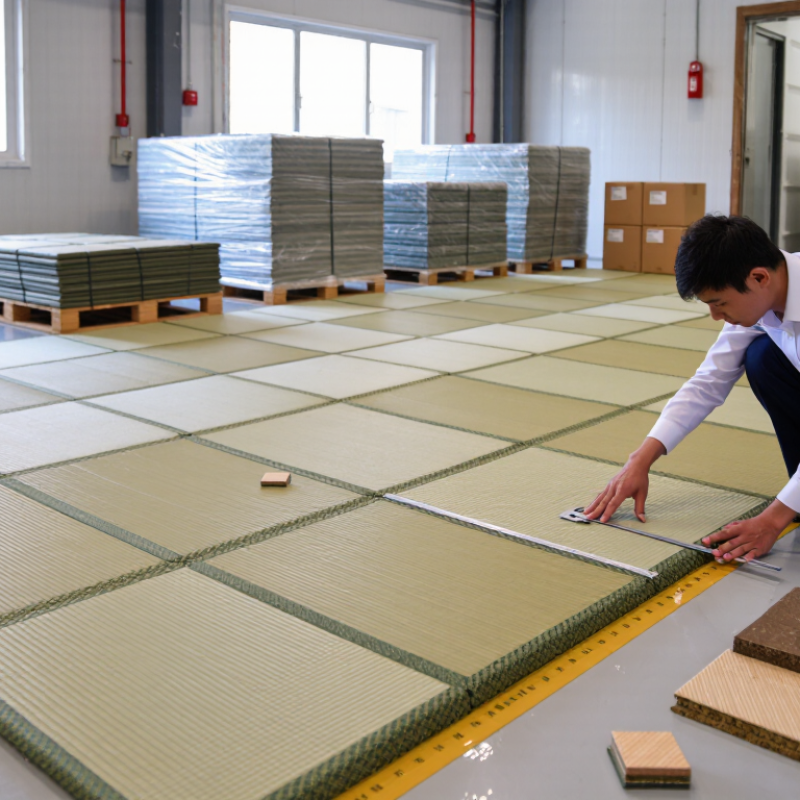
A 4cm tatami mat should be checked as a product, not only as a sample. Measure thickness at five points after 24 hours of unpacking. Record density, rebound, compression recovery, surface flatness, and edge alignment. Ask for material declarations and test reports matching the exact production specification. A certificate for another foam grade proves little. The European Commission’s Safety Gate 2023 report recorded 3,412 product safety alerts, showing why traceability and market-specific compliance matter. Requirements can differ across the European Union, North America, and Asia. Confirm applicable chemical, flammability, labeling, and packaging rules before placing an order.
Tips: Request three samples from separate production batches. Photograph the ruler, underside, seams, and carton labels. Test odor after 48 hours in a ventilated room. Check the mat after repeated folding and a loaded compression test. It may look perfect. That is not enough. The ISO Survey 2023 lists more than one million ISO 9001 certificates worldwide, but certification alone cannot confirm stable output. Review corrective-action records, inspection plans, batch codes, and at least twelve months of delivery performance. Ask for references from comparable export markets, not vague promises. One weakness remains: factory audits capture a moment, while reliability develops over repeated shipments. Build a trial order with measurable acceptance criteria and a written remedy for failed batches.
Verify samples, certifications, and long-term supplier reliability
This practical sourcing scorecard prioritizes the evidence buyers should verify before placing a global order. Sample conformity confirms the 40 mm target thickness and product consistency, while certification documents should be checked for validity and scope. Long-term supplier reliability is assessed through production history, quality records, communication, and delivery performance. The percentages are recommended evaluation weights, not data from any specific company or brand.
Scan QR code to download the app
LSP Products was founded by plumbers over 50 years ago with a focus on unparalleled innovation, superior product quality, and best-in-class service to the plumbing industry. Our primary focus is the new construction market where we develop products that make installations easy and provide significant cost savings to the plumbing/mechanical contractor. LSP has a manufacturing facility located in Monterrey, Mexico and a distribution center in Dallas, Texas. We are proud to offer many products designed and made in North America… About LSP
Submit the form below to receive the document via email.