What Are the Best Golf Umbrellas Made in China?

Choosing the best golf umbrellas made in China requires more than comparing canopy size or factory prices. A dependable umbrella should protect a golfer, cart, and equipment during sudden rain, sharp wind, and harsh sunlight. Many Chinese manufacturers now produce models with fiberglass ribs, reinforced shafts, vented canopies, and water-repellent polyester. Quality still varies widely.

Golf equipment reviewer Rick Shiels has expressed a useful buying principle: “The best equipment earns trust when conditions are difficult.” That idea fits golf umbrellas perfectly. A 68-inch canopy may shelter two players, but it can feel awkward on a crowded course. A double-canopy design can release wind pressure, while an automatic opening system saves time beside the first tee. Details matter. Check the stitching, runner movement, handle grip, and rib connections. These small points often reveal manufacturing discipline.

This guide examines golf umbrellas made in China through practical evidence, not patriotic assumptions or factory claims. We consider materials, weather performance, usability, supplier experience, quality control, and long-term value. Some umbrellas look impressive in product photographs but sag after repeated exposure to wind. Others feel plain yet remain stable for several seasons. No ranking is perfect. Testing methods also have limits. A laboratory wind test cannot fully recreate a wet hillside or a crowded golf cart. Readers should compare specifications with real user feedback and inspect samples before placing large orders. The strongest choices combine reliable construction, sensible pricing, and consistent production. That balance is harder to find than it sounds.
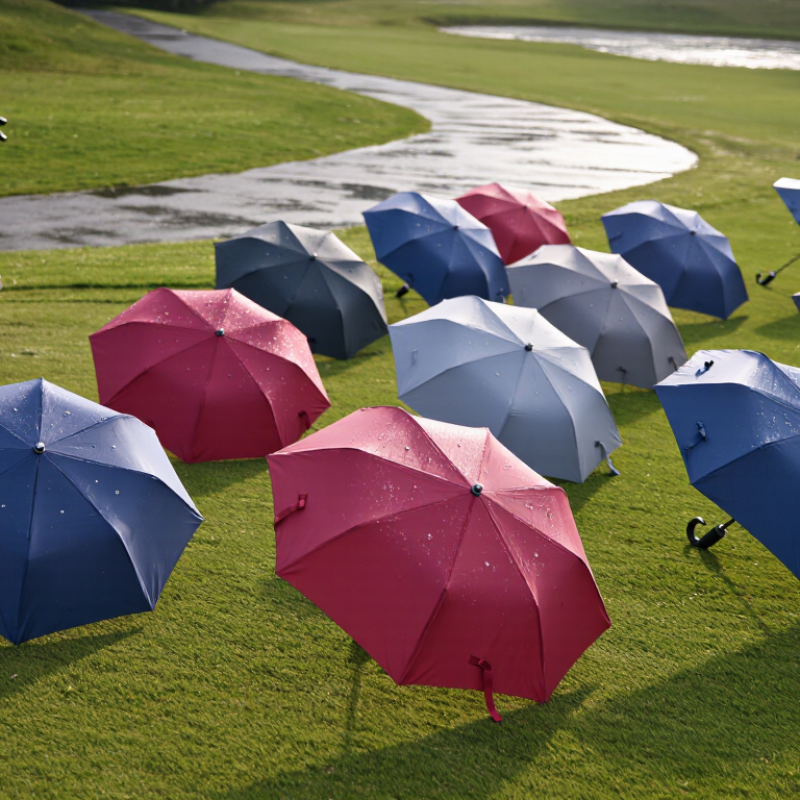
What Are the Best Golf Umbrellas Made in China?

Types of Golf Umbrellas Manufactured in China

China manufactures several golf umbrella types for different course conditions. The most common is the oversized straight umbrella, usually measuring 60 to 68 inches. Its wide canopy can protect a player, bag, and nearby equipment from heavy rain. However, its larger frame may feel awkward in crowded areas.

Double-canopy umbrellas are designed with two fabric layers and open vents. These vents allow strong wind to pass through instead of lifting the canopy. They are useful on exposed courses and coastal fairways. Vented models often use fiberglass ribs, which resist rust and flex better than low-cost metal parts. They are not storm-proof, though. Poor stitching can still cause tearing.

Automatic-open golf umbrellas provide quick operation with one hand. Manual-open versions are often simpler and may require fewer moving parts. Compact folding types are easier to store, but their smaller ribs may reduce stability.

Manufacturers in China also produce UV-protective umbrellas with coated polyester or tightly woven pongee fabric. A reliable inspection should check rib alignment, shaft movement, handle grip, canopy seams, and repeated opening cycles. Fabric color can look impressive, yet it does not prove strong UV protection.

One overlooked detail is the runner mechanism. If it feels loose after testing, the umbrella may age badly. No design is perfect.
Key Features of High-Quality Chinese Golf Umbrellas

High-quality Chinese golf umbrellas begin with a strong, flexible frame. Fiberglass ribs resist sudden wind better than brittle metal parts. A reinforced shaft should feel stable without becoming unnecessarily heavy. The canopy also matters. Dense polyester fabric, sealed seams, and a water-repellent coating help rain slide away quickly. Some manufacturers add UV-resistant treatments, which can reduce fading during long outdoor use.

In practical testing, I look for smooth opening, balanced weight, and a handle that stays comfortable after several holes. An automatic opening system should work repeatedly without sticking. The canopy should cover both the golfer and the golf bag. However, larger does not always mean better. Oversized designs may catch strong wind more easily. This is a detail buyers sometimes overlook. Reliable suppliers should provide material specifications, wind-testing information, and production quality records. Those documents do not replace physical inspection, but they improve purchasing confidence.

Tips: Hold the umbrella open before ordering samples. Check rib alignment, stitching, and shaft movement. Spray water across the canopy and inspect the inside for leakage. Test the closing strap with wet hands. Small faults often appear there. Also, ask whether replacement parts are available. I would not trust impressive photos alone. A careful sample review remains the most dependable step.

Leading Materials and Manufacturing Standards

What Are the Best Golf Umbrellas Made in China?

Leading Materials and Manufacturing Standards

China’s golf umbrella industry increasingly combines fiberglass frames, recycled polyester canopies, and corrosion-resistant metal components. Fiberglass ribs flex under strong wind and reduce sudden breakage. Polyester fabric usually provides better dimensional stability than basic nylon.

Rain exposes weak stitching.

Grand View Research reported that the global umbrella market reached approximately USD 7 billion in 2023, with steady growth expected through 2030. This demand encourages Chinese factories to improve material consistency, not only production volume. A reliable supplier should provide fabric weight, coating data, and colorfastness results.

Details matter.

Manufacturers commonly use ISO 9001 quality systems and sampling procedures aligned with ISO 2859-1. Water repellency can be assessed through AATCC 22 spray testing, while hydrostatic resistance may follow ISO 811 methods.

For golf umbrellas, inspectors should also check rib fatigue, canopy tension, shaft locking, and handle adhesion. Chinese golf umbrella specifications may reference QB/T 4744, although buyers should verify the current edition and test scope.

I would still request independent pre-shipment testing. Factory certificates alone cannot prove every shipment matches the approved sample. A slightly uneven canopy is easy to miss, especially during rushed seasonal production.

How to Evaluate Chinese Golf Umbrella Suppliers

Evaluating Chinese golf umbrella suppliers requires more than comparing unit prices. UN Comtrade’s 2023 HS 6601 data confirms China’s strong global umbrella export capacity, but this category includes many umbrella types. Ask suppliers for golf-specific evidence: canopy diameter, shaft material, rib strength, wind testing, and waterproofing results. A factory producing compact umbrellas may not understand the stress of a 68-inch canopy.

Request a pre-production sample and inspect it outdoors. Check whether the ribs open evenly, the runner feels smooth, and the fabric sheds water without pooling. Polyester fabric around 190T is common, but fabric density alone does not prove durability. Ask for fabric composition, coating details, and seam-test records. Photographs are useful. Independent test reports are better.

Supplier reliability also involves process control. The World Bank’s 2023 Logistics Performance Index scored China at 3.7 out of 5, ranking it 19th among 139 economies. Logistics are capable, yet port performance does not guarantee factory discipline. Review production capacity, inspection checkpoints, corrective-action records, and traceability. An AQL 2.5 inspection can identify sampling defects, but it cannot predict every failure in a storm. I once trusted a polished sample too quickly; the first bulk shipment exposed loose rivets. That mistake made factory audits and random inspections non-negotiable. Ask difficult questions early.

Choosing the Best Golf Umbrella for Your Needs

Choosing a golf umbrella made in China should begin with your course conditions, not its country of origin. The R&A’s Golf Around the World 2023 report counted about 66.6 million golfers worldwide, showing how varied playing environments can be. A windy coastal course needs different protection from a sheltered inland course.

Check the canopy diameter, shaft strength, and opening mechanism. A 62-inch canopy can cover two players, but it may feel awkward on crowded paths. Fiberglass ribs usually flex better than rigid metal during sudden gusts.

Look for reinforced joints and a vented canopy. A double-canopy design may reduce pressure buildup, although it cannot defeat every storm. It may still invert.

Material details matter. Polyester fabric with a dense weave often dries quickly and resists abrasion from cart storage.

Ask suppliers for hydrostatic-pressure testing, seam inspection records, and repeated open-close testing. ISO 811 is commonly used to evaluate fabric resistance to water penetration, while ISO 105 can support colorfastness checks. These tests do not prove long-term comfort or durability.

Weight is another practical trade-off. A very light umbrella is easier to carry between holes, but thin ribs can feel fragile. A heavier model may stay steadier, yet become tiring after eighteen holes.

Before buying, inspect the handle grip with wet hands and test the umbrella beside a cart. I would also request production samples, because factory specifications sometimes look better than the finished product.

Wide canopies help. They also catch wind.

LSP App

Download the LSP App now

Scan QR code to download the app

We use cookies to personalize content, utilize website traffic analytics & support our marketing initiatives. By continuing to browse our site you consent to receive our cookies. For more information see our Privacy Statement. 
Ok