Global chocolate demand is expanding, but buying equipment remains a practical engineering decision. Grand View Research valued the global chocolate market at approximately USD 131.7 billion in 2021. Its report also projected a 4.6% compound annual growth rate from 2022 to 2030. These figures suggest stronger demand for reliable, scalable manufacturing capacity.
A modern Chocolate Bar Production Line must handle more than basic molding. It should deliver stable tempering, accurate depositing, efficient cooling, clean demolding, and dependable wrapping. Buyers also need to examine output speed, chocolate viscosity, bar dimensions, power consumption, sanitation access, and spare-parts support. PMMI reports have repeatedly identified automation, labor availability, and packaging efficiency as important pressures for food manufacturers. The machine may look impressive. The service network matters more.
Quality remains the central test. Milton S. Hershey, a pioneering chocolate manufacturer, famously said, “Give them quality. That is the best kind of advertising.” His principle still applies beside a stainless-steel tempering unit or a cooling tunnel operating at steady temperature. However, no single line suits every factory. A high-speed system may waste capital in a small plant. A compact line may restrict future growth. This guide compares seven production lines for global buyers, considering capacity, flexibility, automation, maintenance, and total ownership cost. The ranking is useful, but not perfect. Local labor skills, climate, electricity stability, and regulatory certification can change the final choice. Buyers should verify every specification with suppliers before signing a purchase contract.
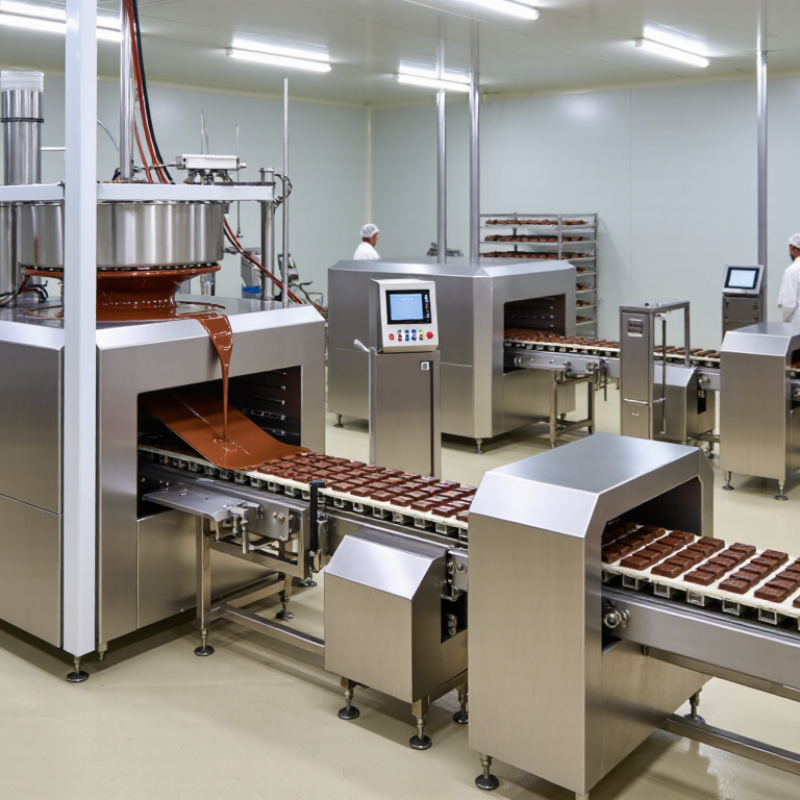
Chocolate bar production lines combine several controlled operations, from ingredient dosing to final wrapping. A typical line begins with weighing cocoa mass, sugar, milk powder, and cocoa butter. Accurate dosing protects flavor consistency and reduces material loss. Mixing creates a uniform paste before refining reduces particle size, often near 20 microns.
Conching develops aroma, removes unwanted moisture, and smooths the chocolate texture. Its time and temperature depend on the recipe, not only the equipment. Tempering then forms stable cocoa butter crystals, which give bars a clean snap and glossy surface. Small temperature changes matter. Poor control can cause fat bloom, streaks, or soft breaks.
The tempered chocolate enters molds through a depositing system, where sensors help control weight and shape. Vibration removes trapped air before cooling tunnels solidify each bar. Cooling must be gradual enough to prevent cracking and condensation. Demolding, inspection, and wrapping follow, with checks for weight, surface defects, seal quality, and packaging alignment. In practice, the fastest line is not always the best choice. A neglected cleaning point can interrupt production, while a complicated control system may challenge smaller teams. Operators still need practical training, careful records, and routine calibration.
For global buyers, the best chocolate bar production line is not always the fastest one. Capacity must match real orders, factory space, and available labor. Request verified output data for each seven shortlisted lines. A line rated at 1,000 kilograms per hour may deliver less with frequent product changes. Ask about tempering stability, cooling time, and measured waste. Numbers need context.
Automation should reduce errors, not simply increase screen controls. Check whether the system manages depositing, molding, cooling, wrapping, and quality checks smoothly. Review sensor accuracy and changeover time. A practical test should include cleaning, recipe adjustment, and emergency stops. Watch the operators. Their feedback often reveals small delays that technical documents hide. This matters.
Product compatibility requires careful testing. Confirm whether the line handles dark, milk, and filled chocolate products. Examine mold dimensions, filling viscosity, bar thickness, and wrapping materials. Request samples made with your ingredients, not only standard factory recipes. My own evaluation mistake was trusting a successful sample without testing a full shift. Performance changed after several hours. Ask for maintenance records, spare-part availability, training plans, and service response times. A reliable supplier should explain limitations clearly, even when the answer is inconvenient.
| Line Type | Typical Output Capacity | Recommended Bar Weight | Automation Level | Compatible Products | Temperature Control | Typical Footprint | Best Fit for Global Buyers |
|---|---|---|---|---|---|---|---|
| Compact Chocolate Bar Molding Line | 100–400 kg/h | 10–100 g | Semi-automatic to automatic | Plain bars, mini bars, seasonal molds, inclusions-free recipes | Tempering and cooling tunnel | 15–35 m² | Start-ups, pilot production, local retailers, and flexible product testing |
| Standard Automatic Bar Molding Line | 500–1,500 kg/h | 20–150 g | Fully automatic | Milk, dark, white, compound, and plain filled bars | Continuous tempering and multi-zone cooling | 60–120 m² | Medium-sized factories requiring consistent output and repeatable quality |
| High-Speed Industrial Molding Line | 1,500–3,500 kg/h | 20–200 g | Highly automated | High-volume standard bars, multipacks, and molded tablets | Automated tempering, cooling, demolding, and monitoring | 120–250 m² | Large exporters and manufacturers with stable demand and long production runs |
| Filled and Center-Filled Bar Line | 300–1,200 kg/h | 25–150 g | Automatic | Caramel, cream, praline, nougat, fruit, and layered centers | Separate chocolate and filling temperature zones | 80–160 m² | Premium and differentiated products requiring accurate filling control |
| Inclusion Bar Molding Line | 400–1,500 kg/h | 20–200 g | Automatic | Nuts, crisped rice, cereal, cookie pieces, dried fruit, and coated inclusions | Tempering with controlled inclusion feeding | 70–150 m² | Brands seeking textured, premium, or region-specific bar recipes |
| Chocolate Enrobing and Slab Line | 300–2,000 kg/h | 15–250 g | Semi-automatic to automatic | Wafer bars, biscuits, caramel slabs, fondant centers, and premade cores | Continuous chocolate tempering and cooling | 60–180 m² | Processors that need product variety without installing a complete molding system |
| Flexible Multi-Format Chocolate Line | 500–2,000 kg/h | 10–250 g | Automatic with recipe controls | Bars, tablets, pralines, seasonal pieces, inclusions, and selected filled products | Programmable tempering and recipe-based cooling profiles | 90–220 m² | Contract manufacturers and exporters serving multiple markets and package formats |
Seven Leading Chocolate Bar Production Line Configurations
Global buyers are comparing flexibility, hygiene, and output rather than machinery size alone. The International Cocoa Organization forecast 2023/24 cocoa grindings at about 4.855 million tonnes, showing sustained demand for processed chocolate products. However, demand does not guarantee a profitable line. Poor mould cooling can still create dull surfaces, cracked bars, and costly rework.
Seven practical configurations cover most purchasing needs. A single-shot line suits standard solid bars. A three-shot line creates layered textures and contrasting colours. Shell moulding supports cream-filled centres. Enrobing coats biscuits, wafers, or centres with chocolate. A slab-forming line cuts large sheets into uniform bars. A cold-forming line handles compound coatings and lower-temperature recipes. A modular depositing line serves seasonal products and smaller batches. The best choice depends on recipe viscosity, bar weight, cooling time, and sanitation access.
The Grand View Research chocolate market report identifies premium and filled products as important growth areas, but market estimates vary by scope. That uncertainty deserves attention. During equipment evaluations, buyers should request verified hourly output using their own recipe, not water or a laboratory sample. The International Confectionery Association also stresses process control, allergen management, and hygienic design across confectionery operations. A useful factory trial checks tempering stability, mould release, cooling uniformity, and packaging synchronization. Sometimes, a smaller modular line performs better than a faster system that cannot change formats without long stoppages.
The chart compares representative nominal throughput levels for seven commonly used chocolate bar production configurations. Actual capacity depends on recipe, bar size, mould format, cooling time, automation level, and line layout.
For global buyers, a chocolate bar production line must satisfy local food, safety, and electrical requirements. Compliance starts with food-contact surfaces, allergen controls, sanitation design, and documented traceability. Ask for material certificates, risk assessments, and electrical test records before signing the contract. A familiar certificate is not automatically valid in every market. Local authorities may require additional inspections.
Installation planning deserves equal attention. Confirm the factory’s floor loading, ceiling height, drainage, ventilation, and power supply. A line designed for 400 volts may need adaptation elsewhere. Leave enough space around tempering units and cooling tunnels for cleaning and maintenance. Small details matter. Measure the doorway, not only the production area. Factory acceptance testing should verify molding accuracy, cooling performance, product changeover, and emergency stops using agreed samples.
Support often decides whether a line becomes profitable. Require illustrated manuals, operator training, wiring diagrams, and a clear spare-parts list. Remote assistance is useful, but it cannot replace skilled local technicians during a midnight breakdown. Check response times, language coverage, software access, and warranty boundaries in writing. Critical parts should be identified by code, not vague descriptions. During supplier evaluation, speak with users operating similar capacities, if possible. Their feedback may reveal cleaning delays, unstable temperatures, or difficult controls that brochures overlook. A lower purchase price can hide installation work, training gaps, or long shipping times. I would also budget for mistakes; first-year adjustments are common, and ignoring them can disrupt seasonal production.
The best chocolate bar production line depends on volume, product design, and available labor. A tabletop line suits small workshops and seasonal testing. A semi-automatic line offers better output with moderate investment. One-shot moulding works well for filled bars and controlled portions. Standard moulding lines support solid bars efficiently. Enrobing lines add a smooth chocolate coating to biscuits or centers. High-speed automated lines serve established factories. Multi-format lines provide flexibility, but their controls and maintenance costs are higher.
Small businesses should compare total ownership cost, not only the purchase price. Consider tempering stability, cooling tunnel length, mould changes, energy use, and wrapping speed. Medium producers often gain efficiency from automatic depositing and faster cooling. Large manufacturers need synchronized systems, reliable spare parts, documented testing, and trained technicians. A low quotation may hide expensive installation work. I have seen output estimates look impressive until real ingredients and packaging were tested.
Tips: Request a factory acceptance test with your recipe and target weight. Check food-contact materials, cleaning access, temperature records, and electrical compatibility. Ask for verified hourly capacity, not marketing figures. Review warranty terms and response times in writing. Leave room for future expansion. It is easy to overbuy equipment, especially when growth forecasts are uncertain. A practical supplier should explain both the line’s strengths and its limits.
Scan QR code to download the app
LSP Products was founded by plumbers over 50 years ago with a focus on unparalleled innovation, superior product quality, and best-in-class service to the plumbing industry. Our primary focus is the new construction market where we develop products that make installations easy and provide significant cost savings to the plumbing/mechanical contractor. LSP has a manufacturing facility located in Monterrey, Mexico and a distribution center in Dallas, Texas. We are proud to offer many products designed and made in North America… About LSP
Submit the form below to receive the document via email.